



PermaSafe Car Cleaner
The Science Behind PermaSafe
Standard antimicrobials and disinfectants kill microbes by poisoning them with hazardous chemicals and are designed to act and dissipate quickly to avoid harming animals and humans. Sadly, as soon as they evaporate, so does their antimicrobial capabilities.
Unlike other antimicrobials, PermaSafe SHIELD is odor-free, non-corrosive, environmentally neutral, non-hazardous, and can remain active for months.
24/7 ANTIMICROBIAL SURFACE & AIR PROTECTION
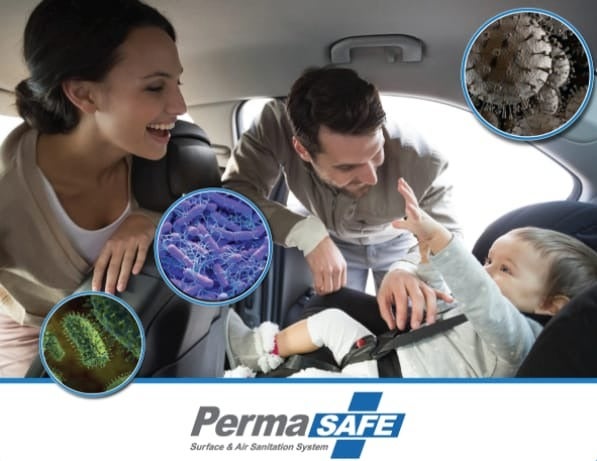
PermaSafe is a revolutionary antimicrobial surface and air protectant that CONTINUOUSLY and SAFELY annihilates passenger cabin germs, bacteria, viruses and other harmful microorganisms.
Uniquely multifunctional, PermaSafe also protects and preserves the look, smell and feel of your vehicle's interior surfaces, from headliners to carpets and everything in between, while also preventing stains, fading, cracking, tears and more.
POWERFUL PROTECTION, POWERFUL PEACE OF MIND
Here at West Knoxville Chrysler Dodge Jeep Ram, we believe in the health and safety of our customers. That's why we recommend getting a PermaSafe sanitation treatment for your vehicle. The sanitary state of your vehicle is not only critical to passenger health and the condition of its carpets, upholstery and other interior surfaces, but also its resale value. Most PermaSafe installations are now available with up to 7 Years of Optional Warranty Protection, covering the vehicle's Seats, Carpet, Dashboard, Door Panels and other Interior Surfaces for:
- Mold, Mildew & Fungi Contamination and Remediation
- Punctures, Tears, Cracks & Loose Upholstery Stitching
- Passenger Cabin and HVAC System Air Quality and Odors
- Stain Damage from Spills of Food, Drinks, Urine, Blood, Etc.
- Fading, Discoloration and other UV Damage
- Zero Deductible and Free Rental Car on all Repairs

Biggest Benefits of Using PermaSafe Car Cleaner
- Repels and resists stains from Liquids, Dirt and other spills
- Kills 99.999% of Bacteria & Viruses. Eliminates germs and other harmful microbes, PLUS odors and allergens
- Prevents future odors, fading, decay and UV damage
- Seals, protects and adds years of life to upholstery and carpets
- Makes interior surfaces antimicrobial and virtually "Self-Sanitizing"
- Disinfects and continuously sanitizes HVAC systems and ductwork. Perpetually purifies passenger cabin air
- It lasts, it continues to protect and remains antimicrobially effective indefinitely
- PermaSafe does it all safely and without the use of any hazardous chemicals
PermaSafe Frequently Asked Questions
FAQ
Is PermaSafe effective on all of the many different materials and surfaces in my vehicle’s passenger cabin?
Yes. PermaSafe SHIELD™ bonds to and is effective on, virtually any surface, whether it’s porous, nonporous, hard, soft, solid or fabric/upholstery. This is an important benefit of PermaSafe as standard disinfectants are, by federal law, only approved for use on hard, non-porous surfaces.
What is the key difference between the PermaSafe System and other antimicrobials in the marketplace?
The differences between the PermaSafe System and ALL other antimicrobial treatments are many. However, the key difference is probably the perpetual antimicrobial control our system provides as a result of PermaSafe SHIELD, the final product applied during a PermaSafe System installation.
Conventional disinfectants and antimicrobials kill microorganisms by poisoning them with chemicals. Due to their toxicity, they are designed to act quickly and dissipate quickly to avoid adverse effects on humans and animals. Unfortunately, as soon as such disinfectants evaporate, so does their antimicrobial capabilities, enabling germs to return almost immediately.
Like conventional antimicrobials, the PermaSafe System includes an effective, immediate initial microbial kill. However, this is where the similarities end, as unlike the others, PermaSafe SHIELD™ eliminates and controls microbes perpetually. And even more uniquely, it does so through a purely physical process, without the use of any harmful chemicals, though it’s unique patented surface modifying technology.
Will regular cleaning of a PermaSafe treated surface reduce its effectiveness?
No. Normal cleaning will not harm or remove the topcoat of PermaSafe SHIELD.™ It is, however, important to note that sanding, or scrubbing PermaSafe SHIELD™ treated surfaces with abrasive cleaners, will partially remove it, requiring spot reapplication to regain effectiveness.
How does the PermaSafe system work?
The PermaSafe System is comprised of two distinct, yet equally remarkable, patented and EPA registered products:
PermaSafe CLEAN, our high-performance, multi-surface cleaner; no-rinse, no-wipe sanitizer and broad-spectrum hospital-grade disinfectant and odor, allergen, mold, mildew, and fungi eliminator.
PermaSafe SHIELD, our long-lasting antimicrobial surface protectant that continuously inhibits the growth and spread of microorganisms and helps prevent the growth and spread of bacteria.
Effective on an almost endless array of soft and hard, porous and nonporous materials and surfaces, a PermaSafe System installation starts by fogging PermaSafe CLEAN throughout the designated area and the HVAC system that services it.
Once clean, disinfected, and deodorized, the same spaces and surfaces are then fogged with PermaSafe SHIELD, our unique antimicrobial surface protectant.
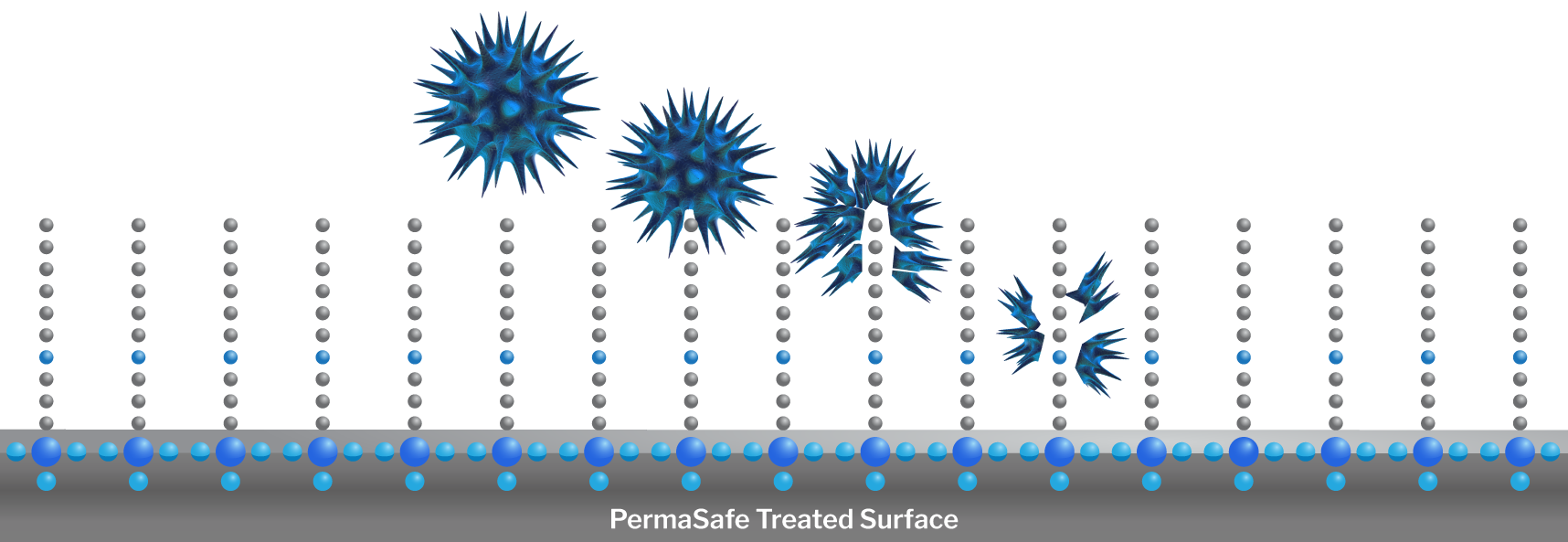
Upon application, the patented active ingredient in PermaSafe SHIELD permanently bonds with the surfaces to which it is applied. As the protective coating dries millions of positively-charged microscopic “spikes” form and extends from the surface.
Because microorganisms are negatively charged, they are electrostatically pulled onto the positively charged spikes and eliminated, as the spikes rupture their cell walls and, essentially “electrocute” them.
Exceptionally multifunctional, PermaSafe’s chemistries also help preserve and protect the look, feel, and smell of treated fabrics and other materials, from curtains to carpets and everything in between.
Even more, than its versatility, what’s most remarkable about the PermaSafe System is it remains antimicrobially effective for months and does so without the use of any harsh chemicals.
How long does PermaSafe last?
While PermaSafe CLEAN acts and dissipates quickly, the subsequent application of PermaSafe SHIELD provides months of 24-7 antimicrobial protection.
SHIELD’s patented antimicrobial agent forms a covalent bond with the surfaces to which it’s applied. In this regard, SHIELD isn’t really a “coating” like paint because its application actually results in the formation of a totally new surface, technically known as a copolymer, which becomes an integral part of the original surface.
SHIELD does not dissipate over time, does not volatilize (give off gasses or chemicals into the air), is insoluble (it won’t wash off), doesn’t leach (move through other materials by any one of a number of physical processes), and isn’t absorbed or consumed (eaten) by the microbes. In theory, it should last and remain antimicrobially effective forever. In practice, it does not. Given the many different surfaces, environments, and conditions SHIELD is subjected to, and other factors, our residual efficacy claim is limited to “up to 90 days.”*
*Inhibits the growth of microorganisms, odor-causing bacteria, bacteria which cause staining and discoloration, fungi, and algae for up to 90 days.
How risky is my car?
Modern Vehicles have become Breeding Grounds for Germs, Bacteria, Viruses and Fungi, all of which are also known as Microorganisms, or “Microbes.”
- Steering Wheel - The average car's steering wheel is home to 700+ harmful bacteria per square inch
- Dashboard Buttons - Touched almost as often as the steering wheel, but seldom cleaned, they average 1400 harmful bacteria per square inch
- Air Conditioning - Heating & Air Conditioning systems are notorious for breeding mold, mildew, and bacteria
- Vehicle Seats - Due to food & drink spills, and occupant created heat and moisture, seats can harbor 2,000+ harmful bacteria per square inch
Is Your Car Making You or Your Passengers Sick?
While any confined space that is frequented by people is prone to microbial activity, increased vehicle use, the popularity of ready-to-eat food and our habit of consuming it in our vehicles, as well as other lifestyle changes, have put drivers and passengers at greater risk of infection. And for motorists whose passengers include those with four legs, or someone who may be ill, wearing dirty shoes or dirty clothes, or even if that extra passenger is nothing more than a bag of trash from your last snack, the risks skyrocket.
Worse yet, there’s been little opportunity to improve this situation. While there is a wide range of upholstery, carpet, and other surface cleaners on the market expressly formulated for automotive interiors, very few offer any microbial protection. And, even if they did, it would be all but impossible to thoroughly treat a passenger cabin’s many different areas, components, and materials with them, let alone under its seats and dashboard or throughout its heating, air conditioning, and ventilation system’s ductwork. Further, any antimicrobial protection provided would be very temporary, disappearing completely the instant the product dried. Until now.
What microorganisms is the PermaSafe System effective against?
The PermaSafe System* kills up to 99.999% of harmful microorganisms, including the following Bacteria, Viruses, and Fungi.
Gram-Negative Bacteria
- Acinetobacter baumannii ATCC 19606
- Pseudomonas aeruginosa ATCC 15442
- Legionella pneumophila ATCC 33153
- Salmonella enterica ATCC 10708
- Klebsiella pneumoniae (NDM-1) ATCC BAA-2146
- Escherichia coli ATCC 11229
- Bordetella bronchiseptica ATCC 10580
- Chlamydia psittaci, Strain 6BC, ATCCVR-125
Gram-Positive Bacteria
- Staphylococcus aureus MRSA ATCC 33592
- Staphylococcus aureus ATCC6538
- Listeria monocytogenes ATCC 15313
- Mycobacterium bovis- BCG
- Penicillin- Resistant Streptococuspenumoniae, ATCC 700677
Enveloped Viruses
- Swine Influenza (H1N1) Virus**
- Respiratory Syncytial Virus**
- Influenza B Virus**
- Hepatitis A Virus**
- Hepatitis B Virus**
- Hepatitis C Virus**
- Human Immunodeficiency Virus (HIV Type 1)**
- Hantavirus (Prospect Hill Virus) University of Ontario**
- Canine Distemper Virus, Strain Snyder Hill, ATCC VR**
- Felid Herpesvirus 1, Strain C-27, ATCC VR-636**
- Feline coronavirus, Strain WSU 79-1683, ATCC VR-989**
- Canine coronavirus, Strain 1-71, ATCC VR-809**
- Canine lnfluenza (H3N8) virus, Strain A/Ca/NY/105913/08, Cornell University**
- Feline Infectious Peritonitis Virus, Strain: WSU 79, ATCC VR-990**
- Rabies Virus, Strain: Flury (HEP), ATCC VR-139**
- Herpes Simplex Virus 1 (Human), Strain HF, ATCC VR-260**
- Porcine Epidemic Diarrhea Virus, Strain CO 2013, USDA APHIS 025-PDV001
Non-Enveloped Viruses
- Rotavirus**
- Norovirus Feline Calicivirus**
- Murine Norovirus (MNV-1)**
- Adenovirus 1, Strain Adenoid 71, ATCC VR-1**
- Canine Parvovirus, Strain Cornell-780916, ATCC VR-2016**
- Canine adenovirus 1, Strain Utrecht, ATCC VR-293**
- Herpes Simplex Virus 1 (Human), Strain HF, ATCC VR-260**
- Feline panleukopenia virus, Strain Philips-Roxane, ATCC VR-648**
- Enterbacter aerogenes ATCC 13048
Fungi
- Aspergillus niger ATCC 6275
- Trichophyton rubrum ATCC MYA
- Trichophyton mentagrophytes ATCC 9533
*The PermaSafe System is comprised of 2 Products, PermaSafe Clean, Step 1 and PermaSafe SHIELD, Step 2.
Do surfaces that have been treated with PermaSafe products need to be cleaned?
The PermaSafe System is not a replacement for routine cleaning. In fact, routine cleaning is recommended to keep it effective, as the antimicrobial surface is very thin, and too much dirt or other contaminant build-ups can cover the spike-like appliances and render them less effective until they are cleaned.
How safe are the PermaSafe System Products?
Nothing is more important to us than your safety. It’s the driving force behind our people, our products, and our corporate policies and procedures.
Both PermaSafe CLEAN, Step 1 and PermaSafe SHIELD, Step 2 are EPA Registered, Food Contact Surface Approved, and neither will stain any surface that water won’t stain. But there’s much more you should know about these two amazing products:
PermaSafe CLEAN, Step 1 is also:
- Carpet Institute Approved
- 100% Biodegradable
- Hypoallergenic
- Non-corrosive
- Non-abrasive
- Rinse and Wipe-free
- VOC – free
- Bleach-free
- Phosphate-free
- Residue-free
- No harsh chemicals
- No skin irritants
- No added fragrance
- No nauseous smells
- No gloves required
- No PPE required
- No dermal irritation
- No ocular irritation
PermaSafe SHIELD, Step 2 is also:
- FDA Approved
- Hypoallergenic
- Water Based
- Odor Free
- Indoor/Outdoor
Safe to Use on, a Vast Range of Food Contact and other Sensitive Surfaces, including:*
- All Cookware
- Countertops
- Cutting boards
- Flatware
- Glassware
- Food wrap
- Water filters
- Air purifiers
- Bedsheets
- Bedspreads
- Men’s underwear
- Men’s outerwear
- Disposable diapers
- Woman’s hosiery
- Intimate apparel
Germ Facts
How Cars Can Make us Sick
- When someone coughs in your vehicle, 3,000+ droplets of germ-laden saliva, traveling up to 50 mph, are broadcast throughout its interior.
- Sneezes are worse, sending some 40,000 tiny droplets, which can remain afloat almost indefinitely, airborne at speeds over 200 mph.
- A sick person’s cough or sneeze can contain 200,000,000 individual virus particles and can infect others up to 10 feet away.
- Germs enter our bodies through our mouths, noses, eyes, and breaks in our skin.
- About 75% of the most common illnesses are spread by hands.
- Every 3 minutes, a child brings his or her hands to their nose or mouth.
Is Your Car Making You or Your Passengers Sick?
While any confined space that is frequented by people is prone to microbial activity, increased vehicle use, the popularity of ready-to-eat food and our habit of consuming it in our vehicles, as well as other lifestyle changes, have put drivers and passengers at greater risk of infection. And for motorists whose passengers include those with four legs, or someone who may be ill, wearing dirty shoes or dirty clothes, or even if that extra passenger is nothing more than a bag of trash from your last snack, the risks skyrocket.Worse yet, there’s been little opportunity to improve this situation. While there is a wide range of upholstery, carpet, and other surface cleaners on the market expressly formulated for automotive interiors, very few offer any microbial protection. And, even if they did, it would be all but impossible to thoroughly treat a passenger cabin’s many different areas, components, and materials with them, let alone under its seats and dashboard or throughout its heating, air conditioning, and ventilation system’s ductwork. Further, any antimicrobial protection provided would be very temporary, disappearing completely the instant the product dried. Until now.
The Common Cold and Uncommon Costs
- The average school-aged American child contracts 6 or more colds per year, resulting in more than 24 million lost school days nationwide every year.
- Americans spend over $5 billion each year on their colds, with about $3 billion spent on doctors’ visits and another $2 billion paid for treatments.
- The average American adult contracts 2 – 4 colds per year, resulting in approximately 50 million lost workdays annually.
- Americans contract a total of about 1 billion colds every year. And there’s no better place to catch one than in the confines of a car or truck cab. Like the flu, most colds are spread through contact with the droplets that are discharged when someone with cold coughs or sneezes. While the infected party can minimize the virus’s airborne attack by covering their mouth when needed, their hands, and every surface area they touch, can be just as dangerous … and costly.
- Over 60 million cases of the common cold require medical attention each year in the U.S.
Secrets of a Dirty Car
- While virtually everyone regularly cleans their home, alarmingly few people give their vehicles the same attention, a concerning fact given automobiles provide such an attractive environment for germs to breed, especially if their occupants eat or leave litter in them.
- Over 90% of drivers claim they have never even thought about the possibility of germs existing inside their vehicles, yet they consider household germ control to be a “top housekeeping concern.”
- The average passenger vehicle interior is 17,000% filthier than the average family home.
- The average public restroom is more sanitary than the average vehicle’s passenger cabin.
- The average vehicle’s passenger cabin hosts 2,144% more harmful bacteria than the average smartphone.
- 50% of drivers admit to being dissatisfied with the level of cleanliness in their vehicles and that they would never allow the same level of sanitation to exist in their homes.
- Over 90% of vehicles test positive for human or animal feces on their floor mats, carpet or in their trunks.
- The average Vehicle’s trunk hosts 1500-2000 bacteria per square inch.
- 46% of vehicle owners claim to clean their vehicles at least once each month. However, practically none have ever disinfected their vehicle’s passenger cabin surfaces; the vital step required to kill both bacteria and viruses.